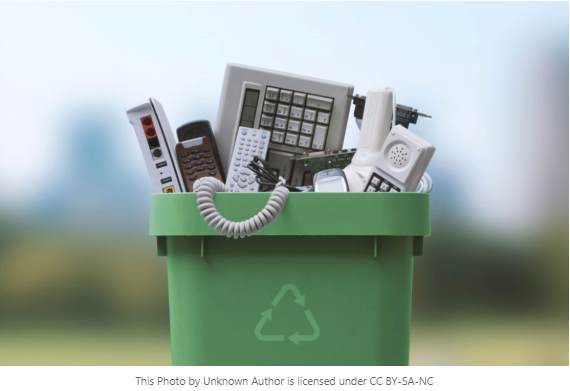
In 2019, Australia generated 511,000 tonnes of e-waste or 20 kg of e-waste (discarded products with a battery or plug such as computers and mobile phones) per person compared with the global average of 7 kg, according to the Australian Department of Climate Change, Energy, the Environment and Water.
The Global E-Waste Monitor 2020 reported that e-waste will be almost double the 2014 figure, driven by higher consumption rates, shorter lifecycles and limited repair options.
Our homes have become havens for abandoned products. Our landfills are bursting at the seams as more and more e-waste is binned each year. We have become a throw away society obsessed with the next new product that clever marketing tells us we can’t live without. In Australia, some States have banned e-waste going into landfills as a way to control the e-waste problem.
We must find ways to diminish the relentless cycle of consume, dispose, repeat!
Imagine a world where broken doesn’t mean binned, and old doesn’t mean obsolete.
The 5Rs of waste management: refuse, reduce, reuse, repurpose, and recycle, is a general approach to tackling the global waste crisis. By implementing these principles, businesses can significantly reduce their environmental impact and contribute to a more sustainable future. However, once the ownership of a product has transferred to the consumer, the responsibility of the environmental impact also transfers to the consumer.
As consumers we also need to dramatically cut our e-waste, to save money, and help our planet stay healthy.
Introducing a new and complimentary set of 5Rs for consumers to breath new life into products: Repair, Restore, Refurbish, Recondition, Rebuild. Here the 5Rs is a consumer approach to managing the life of a product and minimising e-waste.
Repair
Repair refers to the process of fixing or replacing worn or malfunctioning components of a product. It typically focuses on addressing a specific issue to restore the functionality of the product without necessarily overhauling its entire structure. Repairs are often seen as problem-solving actions that target specific faults.
Restore
Restoration is a more comprehensive process that aims to return an item to its original condition or functionality. This may involve significant work, such as replacing major components or refurbishing surfaces to ensure that the item looks and performs as new.
Refurbish
Refurbishing involves cleaning, repairing, and updating an item to improve its appearance and functionality. This process may include minor repairs and cosmetic enhancements but does not usually involve replacing major components. The goal of refurbishing is to make the item usable and visually appealing again.
Recondition
Reconditioning is a process that typically involves disassembling an item, inspecting its parts, and replacing worn or broken components. This method aims to restore the item to a functional state, often requiring specialised skills and tools. While it may improve performance, reconditioning does not necessarily return the item to its original specifications.
Rebuild
Rebuilding is a thorough process that entails completely disassembling an item, inspecting all components, and replacing any parts that are worn or damaged. This process often involves significant structural changes, such as replacing the frame or core components, effectively creating a new version of the item. Rebuilding aims to extend the life of the item and restore it to a condition that may exceed its original performance.
Consumers can take positive actions to breath new life into broken or unwanted products and reduce e-waste by:
1. Fix it yourself: consumers can learn to fix products. Websites such as ifixit.com provide repair guides on many products, and Youtube.com has many videos showing consumers how to repairs all sorts of products.
2. In Australia there are Community Repair Cafes and Hubs where consumers can take their broken products to be repaired by a community of volunteer repairers.
3. Unwanted products in Australia, including electrical goods, can be donated to charities such as St Vincent De Paul or the Salvation Army. These organisations will check and test donated goods and resell them into the community if they are functional and safe to use.
4. In Australia, Ecycle Solutions provides the public with free recycling drop-off points for TVs, computers, computer accessories, and printers. Materials stay out of landfills and be recovered and recycled to use in the circular economy.
5. Consumers living in Australia can also find a broader set of individual actions that can be adopted to reduce all kinds of waste, at cleanup.org.au.
The 5Rs of breathing new life into consumer products starts by questioning what you can do to reduce your own e-waste and taking action so your consumer products do not end up in landfill.